Loading…
Published setup ranges
Free online bike fit calculator
Use height and inseam to compare three saddle-height methods and starting ranges for setback, drop, crank length and frame geometry. Sources and limits included; no account or upload. Edit a result without re-entering your measurements, then compare the calculations side by side.
How and why do you ride?
Comfort = higher and closer; performance = lower and longer, if your body allows.
Your measurements
Only body lengths switch units. Bike settings and calculated adjustment steps stay in millimetres, as marked below and on the result.
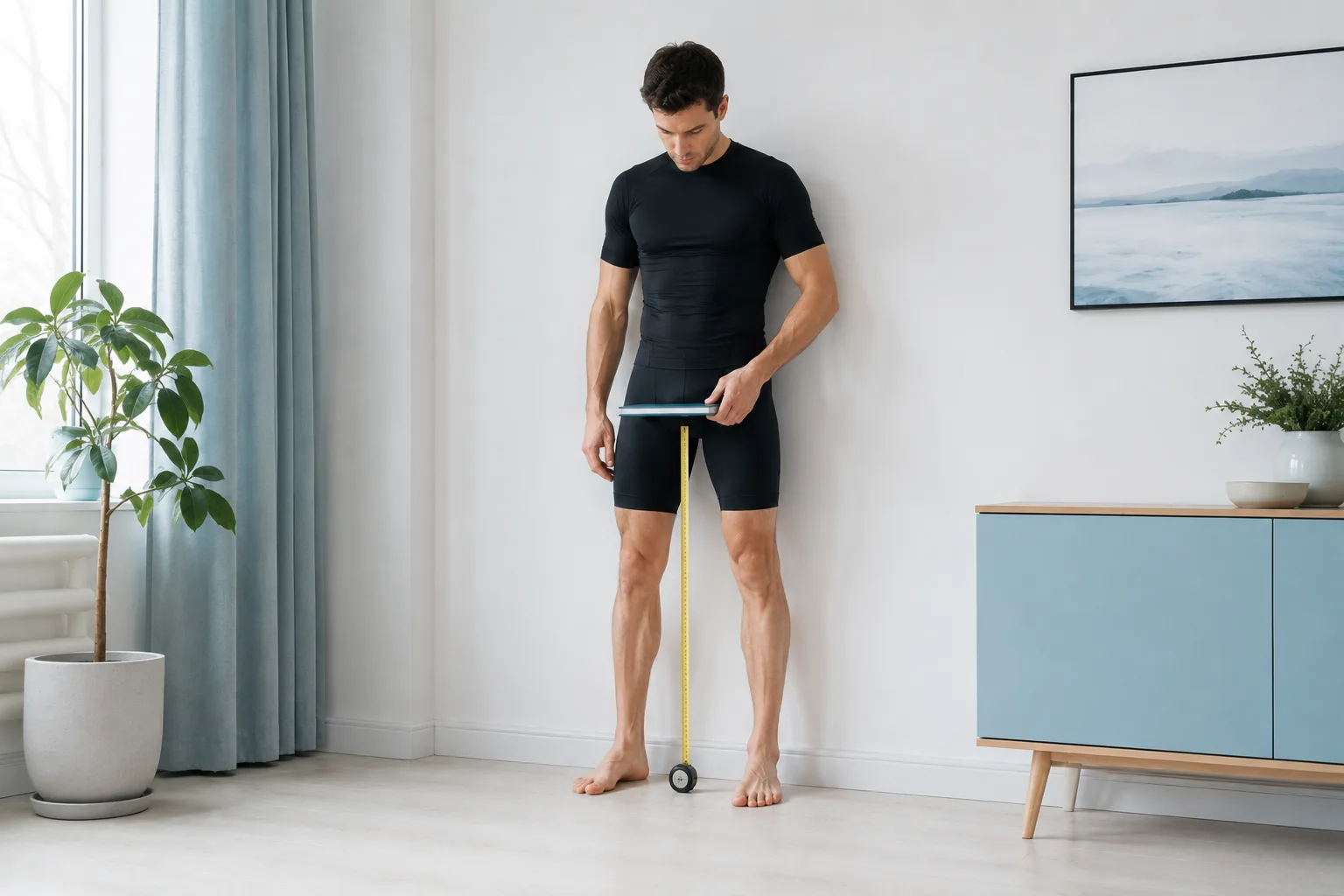
Fine-tune (optional) — narrows the ranges
bony points at the top of your shoulders (AC), centre to centre
cardboard measurement — instructions with the result
Flexibility — a 10-second test
Stand straight, feet together, and slowly bend forward with straight knees. How far do you reach?
Current setup (optional)
Fill this in and we'll show exactly how much to change.
BB centre → top of saddle, along the seat tube
stamped on the inner face of the crank arm
An educational tool, not a medical device · Your result is a starting point · methodology & sources
What the calculator assumes — and does not measure
Saddle height is an app-specific anthropometric estimate. The calculator has no measured knee-angle, femur or shank input. A research paper about a measured angle does not validate this numeric conversion.
Read the calculation assumptions
- Historical ratio
- 0.883 × inseam in mm
- This gives the raw LeMond reference. It does not measure knee motion, segment lengths or an installed bicycle.
- App corrections
- (175 − crank mm) − 4 mm
- The 175 mm baseline and fixed −4 mm term are app conventions, not a measurement of your pedal/shoe assembly. The full tool may estimate the crank term when no current length was entered.
- App angle-band approximation
- (30 − band angle) × 0.0022 × inseam mm
- The angle is a selected reference-band argument, not your measured knee angle. No cited paper was established as validating the app-specific coefficient or its inseam-to-height conversion.
The terms are added before the existing profile modifiers and display rounding. The main calculator assumes the fixed −4 mm term; the separate quick tool adds 4 mm back when its flat-pedal choice is selected. These are transparent software assumptions, not independently verified physical corrections.
Fictional arithmetic, not a rider measurement
For inseam 82 cm and a declared 172.5 mm crank: raw LeMond 724.06 mm; Hamley conversion 721.30 mm; app base at its nominal 30° argument 722.56 mm. Its 25° and 35° arguments give 731.58 and 713.54 mm before profile modifiers. They do not show that a person actually has any of those knee angles.
The dynamic band adds 5° to the selected static band as an app convention. It is not a universal conversion between instruments. A study-specific 2D/3D correction, a projected phone angle and a static goniometer result cannot be silently substituted for each other. Tracking confidence and repeated agreement do not certify absolute accuracy.
A calculated reference is not an installed coordinate. An optional current setting is your declaration, not something the app inspected. Read the physical endpoint and repeatable-measurement guides separately. No number here approves compatibility, installation, health, comfort, performance or readiness to ride.
What this calculator computes — and on what evidence
This free calculator combines historical references with explicitly stated app conventions. It shows the raw LeMond 88.3%-of-inseam rule and the Hamley 109% rule beside an app-specific saddle-height approximation. The approximation starts from inseam, a declared or estimated crank term, fixed corrections and a selected angle-band argument. It does not receive or calculate a measured knee angle. A paper about measured knee angles does not validate the app-specific coefficient or certify an individual fit.
The nine result items also include setback, bar drop, crank length, widths, cleat position, frame reach/stack and an angle reference. Their profile choices and millimetre bands are software estimates, not measurements of an installed bicycle or validated individual prescriptions. In one study of 11 trained male cyclists, the 109% condition missed that study's angle reference in 73% of cases; that is not an app failure rate. In "Why this result?", source type and the dated identity/reading check remain separate from the app rule. A systematic review, peer-reviewed paper, conference abstract or convention is not automatically proof of every number shown.
A separate camera workflow can estimate projected movement under its own recording and quality limits; it does not verify every physical coordinate or turn a calculator range into approval. You can inspect the live camera check. For the background, read the calculation assumptions and source audit or start with goal-dependent reference bands or browse all guides.