Crank length calculator and bike-linked swap assistant
Compare the cranks on your bike with a candidate size, then see the coupled geometry before you buy or adjust anything. The assistant gives you a convention-based starting band, the signed crank-length difference, the saddle move needed to preserve bottom-of-stroke leg extension, and the resulting change in top-of-stroke pedal-to-saddle space. If the result is worth testing, continue with one saved bike, exact component references, a mechanic hand-off and fresh physical measurements after two or three rides.
Free · no account · no upload · exact geometry plus a private measured trial, without promised watts, joint angles or pain outcomes
Have a shortlist? Choose Whole crank shortlist below to keep 2–6 alternatives together, compare an unchanged saddle with a conditional vertical model and review a complete discussion note. No saved bike or body measurement is needed for that separate workspace; it does not choose or install a crank.
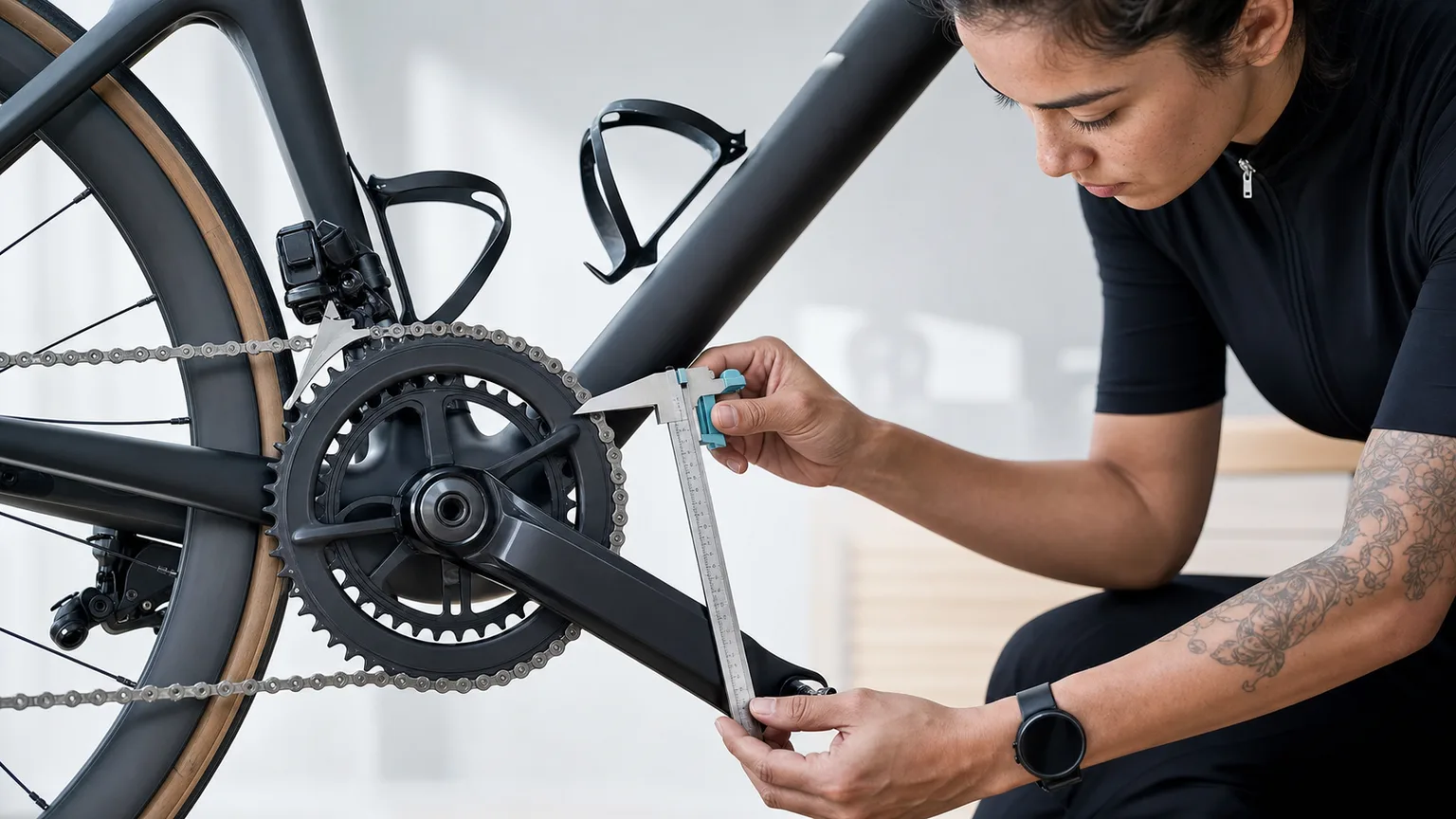
Crank length is centre to centre, not the arm silhouette
Confirm the installed size from the actual bottom-bracket and pedal-spindle centres or the exact manufacturer specification. The calculator compares that measured baseline with one declared candidate.
Using pedal power meters with this crank?
The physical arm length and the connected device setting are separate records. Identify the controlling device and observed readback; this calculator neither pairs a sensor nor changes its setting.
The link passes no entered values and changes no field or acknowledgment.
Choose your comparison workspace
Compare one length change, keep 2–6 lengths together, or retain 2–4 whole shell/BB/spindle/ring declarations without a saved bike. The interface sheet is not a parts chooser. Switching mode discards unsaved inputs in that mode. It does not undo saved data or a save already started.
Compare your crank change
Use the length stamped on each crank arm. Your measurements stay in this page; nothing is uploaded.
Your comparison
Start with two real crank lengths
You will get the signed component change, the saddle-height compensation and the exact change in top-of-stroke space. No watt, pain or joint-angle promise is inferred from those dimensions.
Bike-linked crank swap
Opening local bike passports…
Your profiles and unfinished crank plans stay on this device.
What the calculator can—and cannot—tell you
Crank length is the centre-to-centre distance from the bottom-bracket axle to the pedal axle. A change alters the radius of the pedal circle. That gives us two useful mechanical consequences without needing a body model. If you replace a 172.5 mm crank with a 165 mm crank, the pedal hangs 7.5 mm closer to the bottom bracket at the bottom of the stroke. Raise the saddle 7.5 mm and the original bottom-of-stroke pedal-to-saddle distance is restored. At the top, both changes work in the same direction: the pedal is 7.5 mm lower relative to the bottom bracket and the saddle is 7.5 mm higher, creating 15 mm more pedal-to-saddle space.
Those dimensions are geometry, not physiology. They do not tell us the exact change in hip or knee angle for a particular rider because limb proportions, foot angle, cleat position, saddle setback, pelvic motion and riding posture all matter. They also do not promise that a symptom will improve. The responsible sequence is to predict the mechanical delta, make one reversible change, then use the on-device camera check to observe how you actually move.
The starting range shown by the tool reuses OpenBikeFit's existing inseam-and-discipline convention. It uses practical 2.5 mm bands rather than pretending that one body measurement identifies a uniquely correct crank. Time-trial and mountain-bike contexts bias that band shorter for different reasons: top-of-stroke room in a closed aero posture for TT, and pedal-circle clearance in technical terrain for MTB. Treat the band as a shopping filter, not a prescription. A candidate outside it is not automatically wrong, and a candidate inside it is not automatically right.
Geometry becomes movement
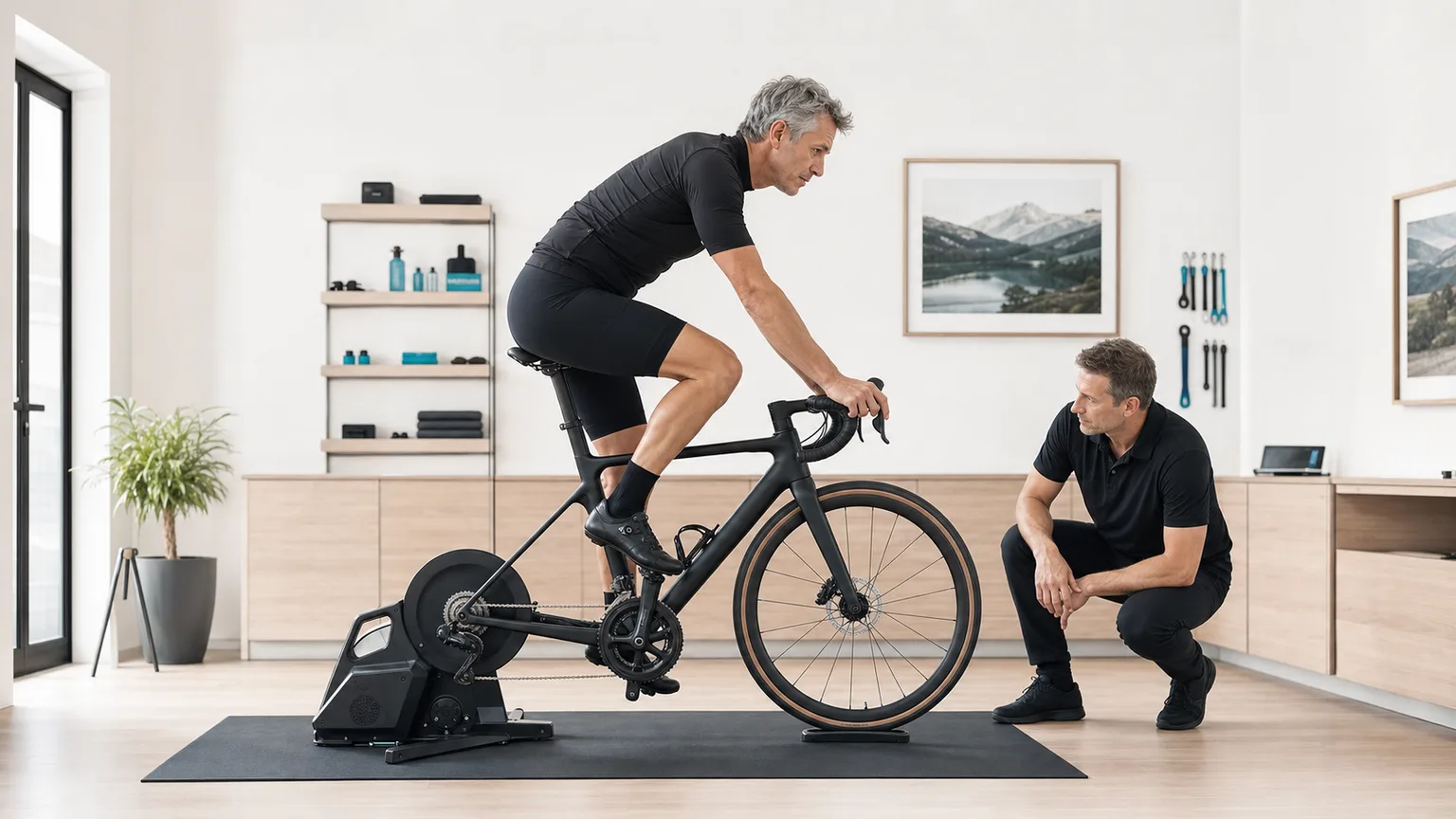
Re-check the top of the stroke in your real riding position
A shorter radius can create more top-of-stroke space, but the rider still validates that direction on the same bike, gearing and hand position. Observe natural cadence and stop if red flags appear.
Why power is not the decision rule
The best-known crank-length power experiment deliberately tested an enormous 120–220 mm span. Martin and Spirduso found maximal power differed by only about four percent across that extreme range when pedalling rate and pedal speed were considered. Barratt and colleagues later found that when cadence was optimized, crank length did not materially rearrange how maximal power was distributed between the hip, knee and ankle. These results do not mean every crank feels identical; they mean a small real-world swap should not be sold as a guaranteed watt gain.
Ferrer-Roca and colleagues studied much smaller changes closer to an actual purchase decision. They did not find an efficiency or heart-rate benefit from the crank change, while the longer option increased peak hip and knee flexion. That supports a directional statement—crank length changes the movement range demanded over the stroke—without giving us a universal ideal or a promised clinical outcome. Acute lab studies also do not establish long-term comfort, adaptation or injury effects for one rider.
Cadence is part of that boundary. A shorter radius can feel more “spinny,” and riders may naturally use a different rpm. Compare in easy gearing and let your cadence settle rather than forcing the old gear or rpm. If you want the complete explanation, read crank length: what actually matters, or inspect the claim, sources and limitations in the public OpenBikeFit methodology.
Sources already used by OpenBikeFit
These studies support the limited claims above. The practical inseam bands remain fitter convention, clearly separated from the peer-reviewed findings.
Peer-reviewed · 2001
Determinants of maximal cycling power: crank length, pedaling rate and pedal speed
Sixteen trained cyclists tested 120–220 mm cranks. Maximum power ranged from 1149 to 1194 W, with significant differences between some lengths. Cadence and pedal speed mattered; these results do not establish one length or guarantee equal power for every rider.
Identity + abstract checked ·
NLM identity and public abstract checked; full text and app validation not established.
Effect of crank length on joint-specific power during maximal cycling
Fifteen trained cyclists tested 150–190 mm cranks. Relative joint powers did not significantly differ at optimized cadence, but some differences appeared at fixed 120 rpm. The finding is conditional, not a universal no-effect claim.
Identity + abstract checked ·
NLM identity and public abstract checked; full text and app validation not established.
Acute effects of small changes in crank length on gross efficiency and pedalling technique during submaximal cycling
Twelve amateur road cyclists tested their preferred length and +/-5 mm at fixed cadence and three workloads. Gross efficiency and heart rate did not significantly differ, while some joint-motion measures did. This acute protocol is not a personal crank-length prescription.
Identity + abstract checked ·
NLM identity and public abstract checked; full text and app validation not established.
Length is one number; interface and pedal installation decide the route.
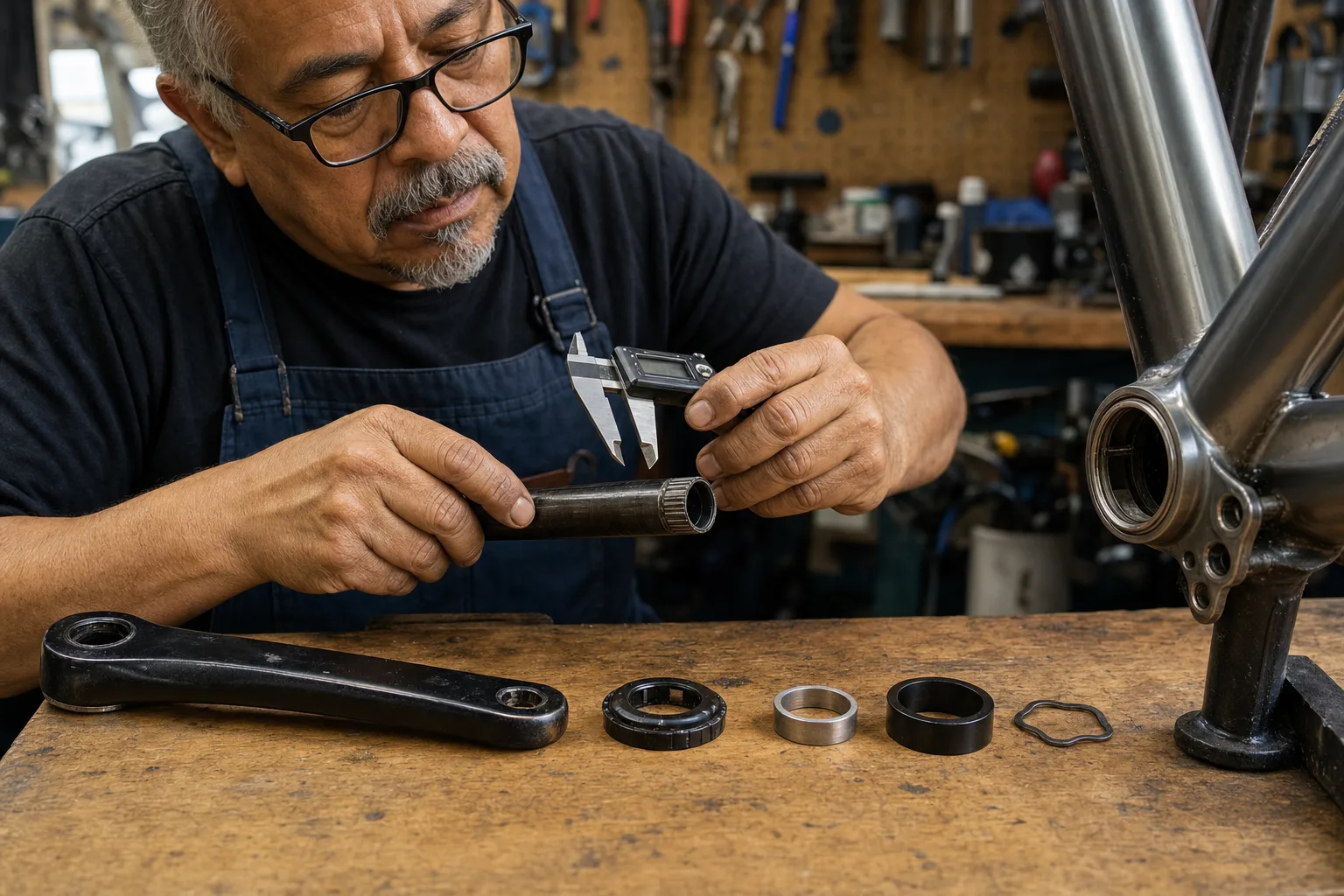
The model can preserve saddle height while comparing lengths. It cannot identify a crank interface, bottom-bracket compatibility or pedal-thread condition from the number alone.
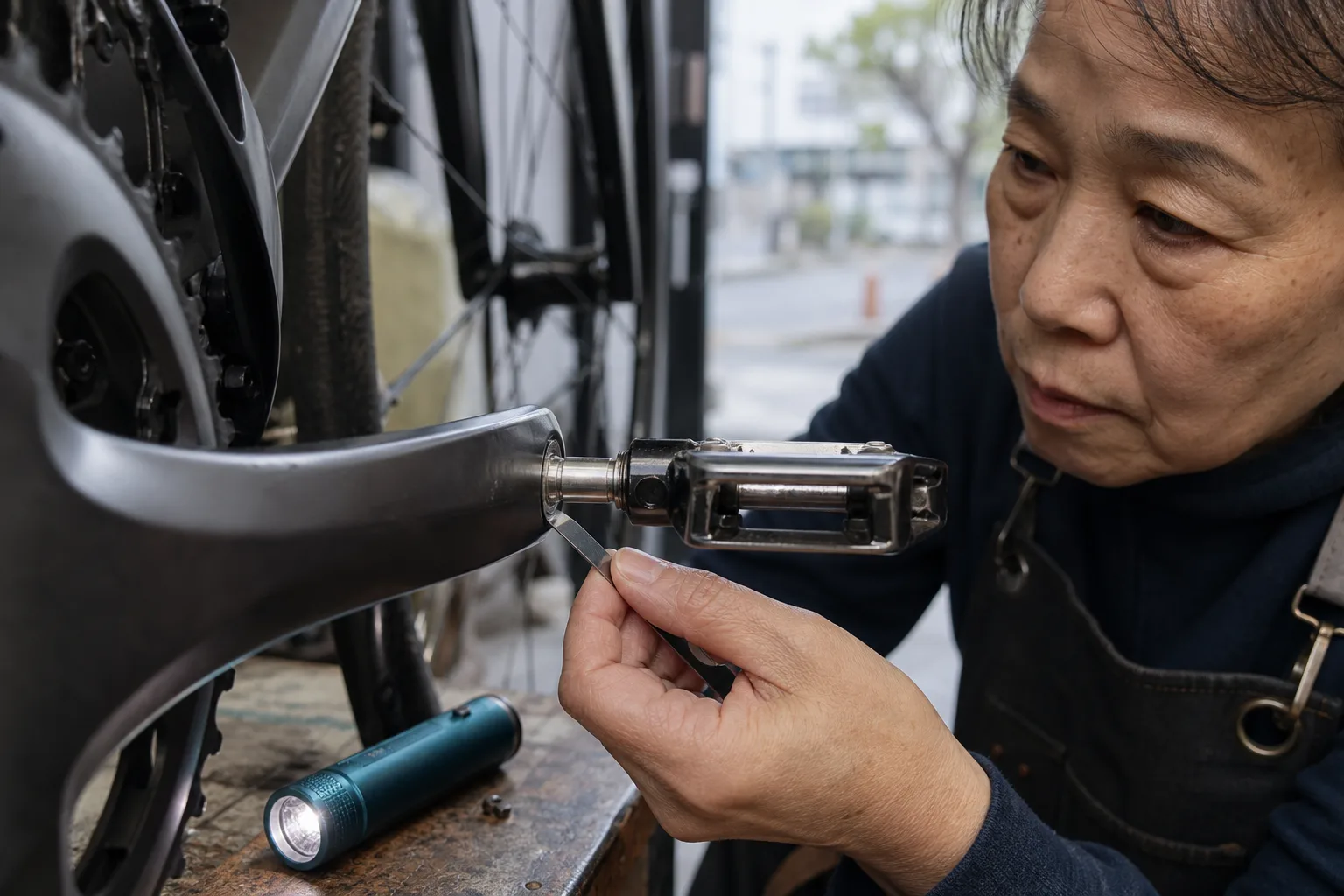
01Identify the spindle, preload ring and spacers before a crank change.02Check the pedal shoulder and washer seat after a crank change.