Crank length: why power doesn't care, and your hips do
Across cranks from 120 to 220 mm, maximal power changes by about 4%. What crank length really changes is how far your hip and knee fold on every stroke — how to size it, and the saddle-height rule everyone forgets.
Published 8 July 2026 · OpenBikeFit
On this page
Model the linked change
Plan a crank-length trial
Compare two crank lengths, preserve the baseline and carry the saddle correction into a re-check.
Open toolCrank length attracts a special kind of obsession. It's stamped right on the arm, it comes in tidy 2.5 mm steps, and the internet is full of riders who swear that going shorter — or longer — transformed them. The research says something less dramatic and more useful: power barely notices crank length, but your joints notice it on every single stroke.
That asymmetry — irrelevant to power, relevant to joint range — is worth internalising, because it inverts how cranks are usually sold. You don't buy shorter cranks to go faster. You buy them, sometimes, so your hip stops closing off in a low position or your knee stops folding quite so deep over the top.
The quick answer
For power, crank length is a rounding error: ride what you have. For your body, shorter is the direction with a real mechanical argument — less hip and knee flexion over the top of every stroke. Don't replace working cranks preventively. When you're buying anyway, size by inseam, roughly 160–165 mm below a 74 cm inseam up to 170–175 mm at 92 cm and above — and raise your saddle by exactly the length you removed.
The power evidence is unusually good
Most bike-fit questions suffer from thin evidence. This one doesn't. Martin & Spirduso (2001) had cyclists produce maximal power on cranks from 120 to 220 mm — a range far wider than anything sold for a road bike — and power varied by about 4% across the whole span: 1149 W on the 220 mm cranks versus 1194 W at 145 mm. What actually determined output was pedal speed and cadence: riders simply spin shorter cranks faster, and the muscles don't much care how lever length and rpm multiply out.
Two details make the finding hard to dismiss. The tested range was deliberately absurd — 120 mm is comically short, 220 mm comically long — so any realistic choice, say 165 versus 175 mm, lives inside a small fraction of that already-small 4%. And the result has a mechanism, not just a p-value: power is force times pedal speed, and riders freely adjust cadence to keep pedal speed near optimal on any sane crank.
Barratt and colleagues (2011) then asked whether crank length at least changes which joints do the work. With cadence optimised, it doesn't: across 150–190 mm, the split of power between hip, knee and ankle stayed the same. And within the ±5 mm range of a realistic swap, Ferrer-Roca et al. (2017) found no change in gross efficiency at all. If someone promises watts from a crank swap in either direction, the burden of proof sits with them.
What crank length actually changes
Geometry. The pedal travels a circle whose diameter is twice the crank length, and the top of that circle is where things get tight: a longer crank lifts the pedal higher at the top of the stroke, folding the knee tighter and closing the hip further. Ferrer-Roca et al. (2017) measured exactly this — efficiency unchanged, but peak hip and knee flexion increased with the longer crank. That is the whole trade in one sentence: extra length buys nothing measurable and costs joint range.
This is why the professional peloton has drifted shorter, and why the logic transfers to the rest of us in specific situations. In an aggressive aero tuck the hip is the bottleneck, so a shorter crank keeps it more open over the top — which is why time-trial guidance runs 2.5–5 mm shorter than road. And when the front of a knee complains — deep flexion under load being the mechanism — reducing how far it folds each stroke is one of the levers with a plausible rationale. If you have neither problem, shorter cranks are a solution in search of one.
There's a quieter fit benefit too: a shorter crank lowers the knee's highest point, which adds a little clearance between thigh and torso at the same bar height. Fitters reach for it when a rider wants a lower front end without the hip pinch — it's a fit lever as much as a drivetrain part.
Sizing, if you're buying anyway
Bands, not formulas. We deliberately skip the old proportional rules (0.216 × inseam and friends): they were never peer-reviewed, and the power data above says the precision they imply is fake.
- Inseam under 74 cm: 160–165 mm.
- Inseam 92 cm and above: 170–175 mm.
- In between: the bands scale between those endpoints — our free calculator does this from your inseam and discipline.
- TT/triathlon: 2.5–5 mm shorter than your road size, to keep the hip open in the tuck. MTB: often shorter too, but for ground clearance — a different reason entirely.
Expect the first rides on shorter cranks to feel slightly odd and 'spinny' — the same speed arrives at a marginally quicker rhythm, which is Martin's pedal-speed mechanism working as intended. The feeling fades.
The saddle-height coupling — don't skip this
The pedal at the bottom of the stroke hangs one crank-length below the bottom bracket. Change the crank and you've changed your leg's reach to the pedal by the same amount: fit 5 mm shorter cranks and your saddle is now effectively 5 mm too low, so raise it 5 mm to restore the same extension. This coupling is the most common way crank swaps go wrong — the new cranks get blamed for what is actually a saddle-height error.
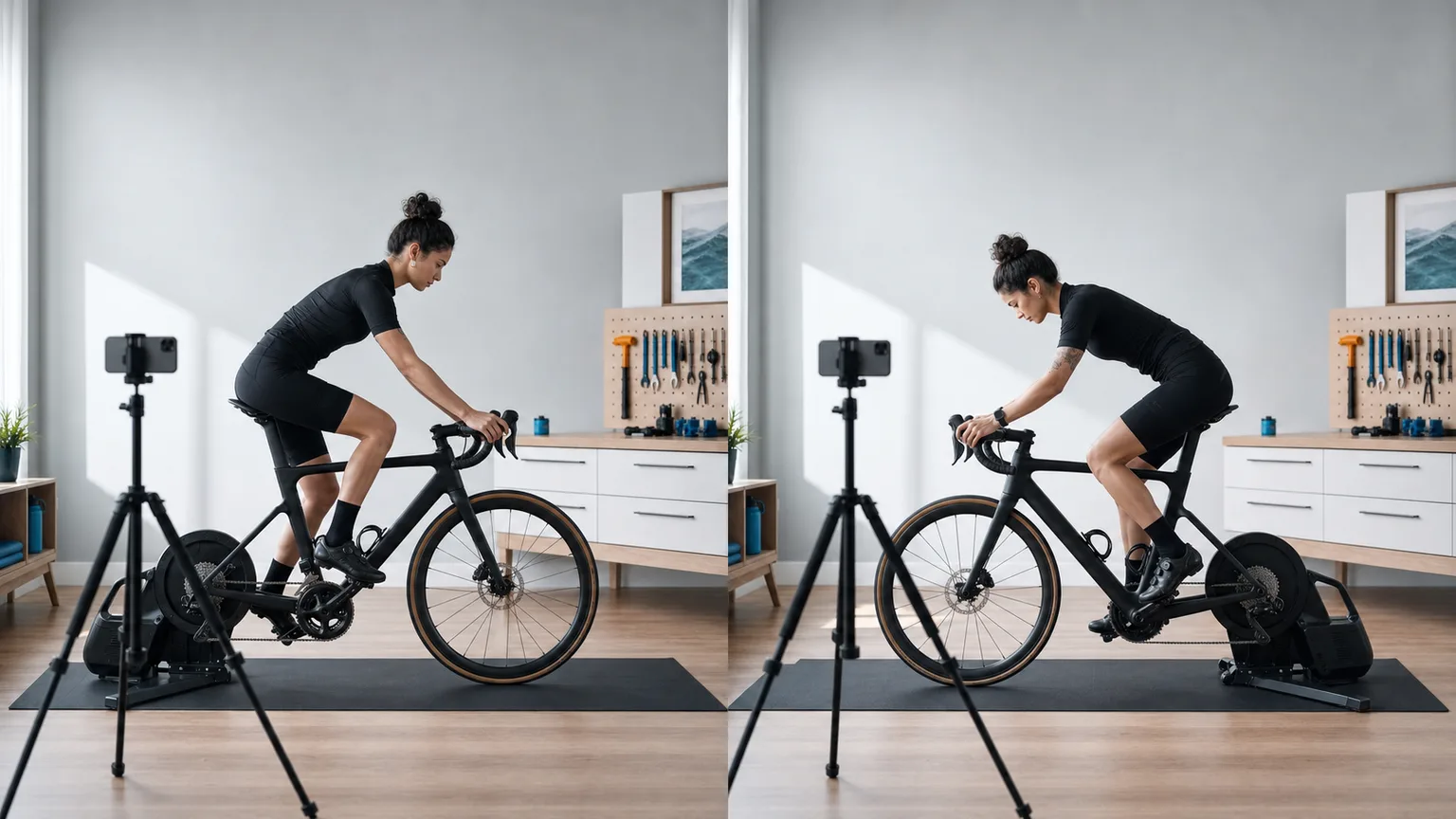
After any crank change, re-verify rather than trust arithmetic: film a side-on pedalling clip or run our camera check, and confirm your knee angle at the bottom of the stroke is back where it was before the swap.
An honest bottom line
The 2024 systematic review of position research (Husband et al.) found scientific consensus only for saddle height, and crank length is one of the better-studied variables outside it — with the honest summary being a null result for power plus a clear direction for joint range. One caveat we'd rather state than hide: these are acute studies, measuring power and efficiency on the day. The long-term injury payoff of shorter cranks is mechanically plausible, not proven.
So: ride what you have. When you buy, err shorter within your band rather than longer. And whatever you change, move the saddle with it.
Practical questions
Frequently asked questions
Does crank length affect cycling power?
Essentially no. Martin & Spirduso (2001) measured maximal power across cranks from 120 to 220 mm and found only about 4% variation (1149–1194 W); within the ±5 mm range of a realistic swap, efficiency doesn't change at all (Ferrer-Roca et al., 2017). Cadence and pedal speed determine power output — crank length mostly just sets the rhythm.
How do I know what crank length I have?
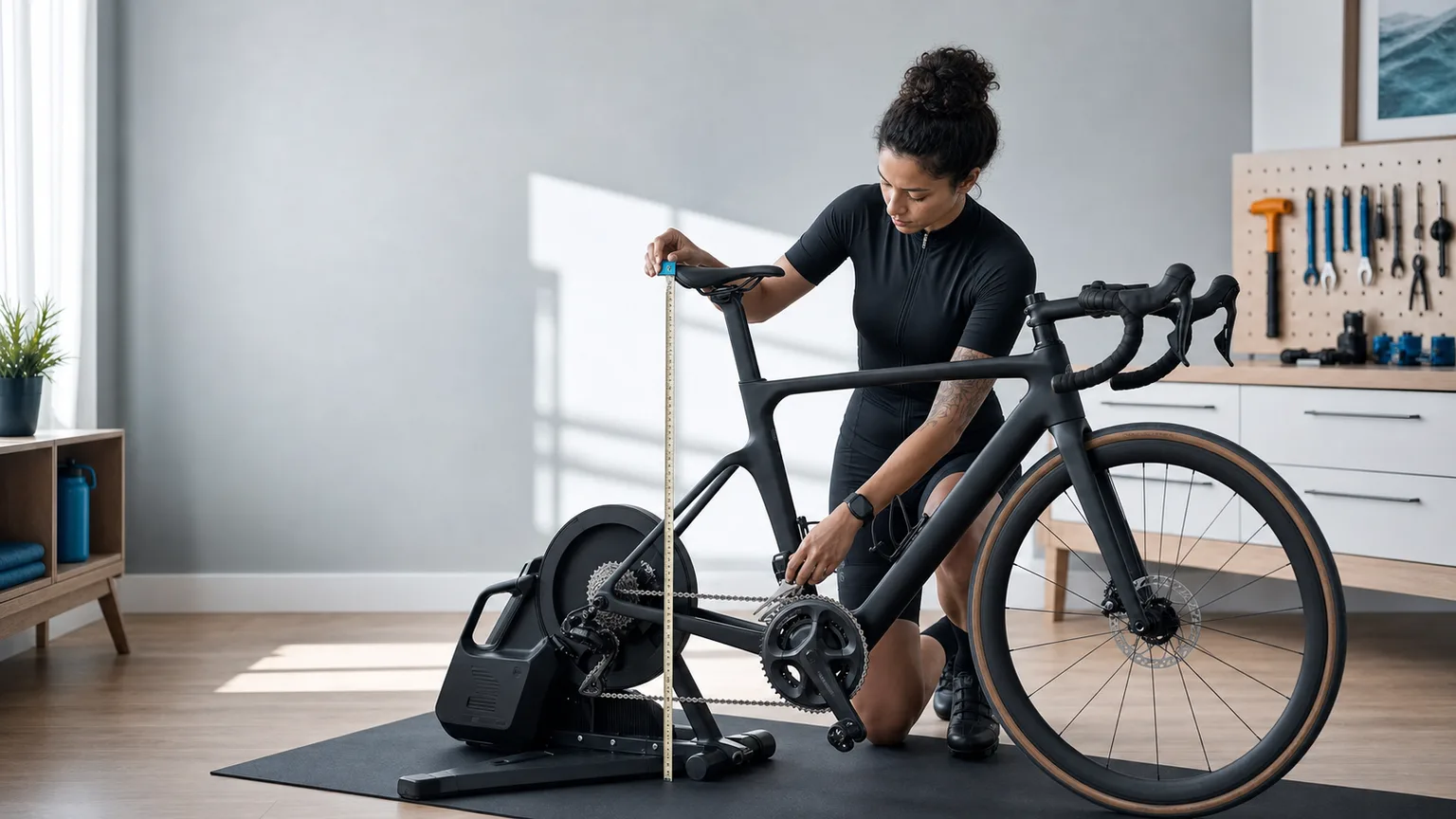
It's stamped or printed on the crank arm itself, usually on the inside (back) face near the pedal threads — 165, 170, 172.5 and 175 mm are the common road sizes. If it's worn off, measure from the centre of the crank bolt (the axle) to the centre of the pedal axle.
Should I get shorter cranks?
Not preventively — a working crankset earns no replacement on power grounds. Consider shorter when you're buying anyway, or when there's a concrete problem shorter cranks address: a closed-off hip in an aero position, front-of-knee pain, or feeling cramped over the top of the stroke. If you do switch, raise your saddle by the same amount you shortened.
What crank length should I ride for my height?
Size from inseam rather than height: roughly 160–165 mm below a 74 cm inseam, scaling to 170–175 mm at 92 cm and above, with TT/triathlon set 2.5–5 mm shorter to keep the hip open. These are practical bands, not laws — the measured power cost of being 'wrong' by 5 mm is essentially zero.
Evidence trail
Sources
- peer-reviewedMartin J.C., Spirduso W.W. (2001). Determinants of maximal cycling power: crank length, pedaling rate and pedal speed. European Journal of Applied Physiology, 84(5):413–418
- peer-reviewedBarratt P.R., Korff T., Elmer S.J., Martin J.C. (2011). Effect of crank length on joint-specific power during maximal cycling. Medicine & Science in Sports & Exercise, 43(9):1689–1697
- peer-reviewedFerrer-Roca V. et al. (2017). Acute effects of small changes in crank length on gross efficiency and pedalling technique. PubMed 27484153
- systematic reviewHusband S.P., Wainwright B., Wilson F. et al. (2024). Cycling position optimisation — a systematic review. Journal of Sports Sciences, 42(15)