How to set your saddle height: the three methods, compared honestly
LeMond's 88.3%, Hamley's 109% and the Holmes knee-angle method — what the research actually says, a worked example, and a step-by-step you can do at home tonight.
Published 8 July 2026 · OpenBikeFit
On this page
Put the guide to work
Compare saddle-height methods
Compare the three methods and keep the knee-angle check visible beside the result.
Open toolSaddle height is the one bike-fit dimension where science has reached a real consensus — and it is still the one most riders get wrong. Set it too low and your knee bends deeply under load on every pedal stroke, pressing the kneecap into the femur; too high and your hips rock while the hamstrings and the back of the knee get overstretched. Both errors cost comfort first and power second.
The quick answer
Set your saddle so that your knee is bent 25–35° when the pedal is at its lowest point and your foot sits as it does when riding. If you can't measure the angle right away, start at 0.883 × your inseam, measured from the centre of the bottom bracket to the top of the saddle along the seat tube — then verify the angle and adjust. That verification step is not optional politeness; it's where most of the value is.
The three classic methods
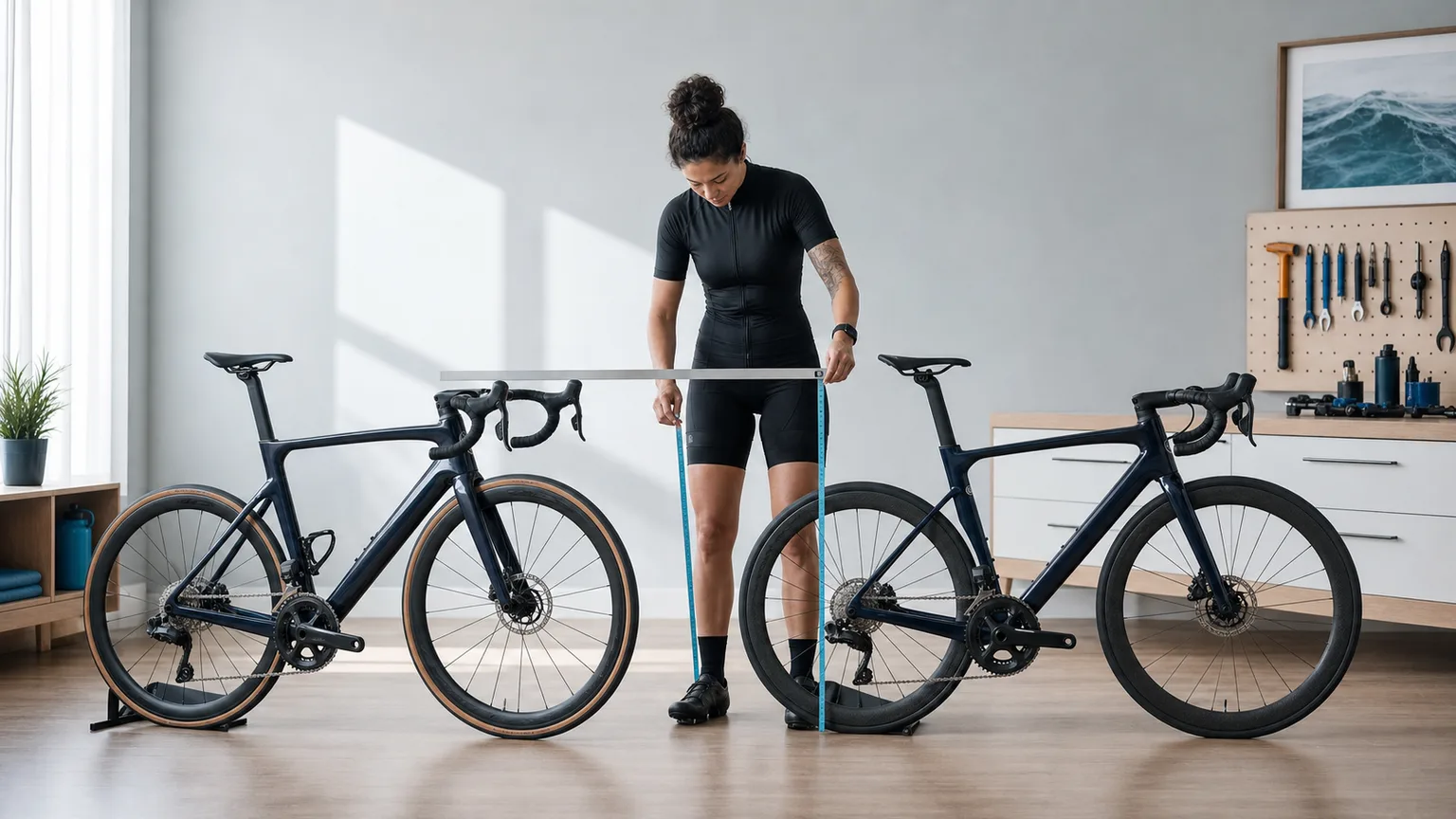
1. Hamley & Thomas (1967) — the 109% rule. Multiply your inseam by 1.09 and set that distance from the pedal spindle (at its lowest position) to the top of the saddle. It came from ergometer experiments and has been repeated for half a century. In modern testing it tends to put riders high: when researchers checked it against the knee-angle reference, most riders landed outside the target window.
2. The LeMond method — 88.3% of inseam. Popularised by Greg LeMond (the method is actually his coach Cyrille Guimard's), it measures 0.883 × inseam from the bottom-bracket centre to the saddle top. It's convenient because it references the bottom bracket, but the constant silently assumes ~175 mm cranks and 1980s shoes with thick leather soles. With modern clipless pedals most fitters subtract 3–5 mm, and if you run shorter cranks you need to add the difference back.
3. Holmes et al. (1994) — the knee angle. Instead of scaling a body segment, measure the thing you actually care about: how much your knee bends at the bottom of the stroke. Holmes and colleagues, working from overuse-injury data, recommended 25–35° of flexion. Later work sharpened this: Peveler (2008) found a 25° setting used significantly less oxygen than 35° — and Bini's 2011 systematic review recommends 25–30° as the best trade of economy against injury risk.
Why the knee angle wins
Formulas scale one number (your inseam) and assume the rest of your body is average. Your femur-to-shin ratio, foot length and pedalling style are not average — nobody's are. Peveler & Green (2011) put a number on the damage: heights set by the 109% formula fell outside the 25–35° window in 73% of riders. The formula isn't useless — it's a fine starting estimate — but it is a starting estimate, not an answer.
There's one more subtlety the classic methods ignore: static vs dynamic. Measured with a goniometer while you sit still, 30° might be your angle; measured mid-pedal-stroke on video, the same position reads about 5° more flexed (Fonda 2014). Dynamic measurements — like our in-browser camera check — should target 30–40°.
Step by step, at home
- Measure your inseam. Barefoot, back against a wall. Press a hardcover book firmly into your crotch — as firmly as a saddle presses — spine against the wall. Measure floor → top edge of the book. Do it twice; take the average.
- Compute your starting height. Use our calculator, which runs all three methods and corrects LeMond's constant for your crank length — or do 0.883 × inseam by hand.
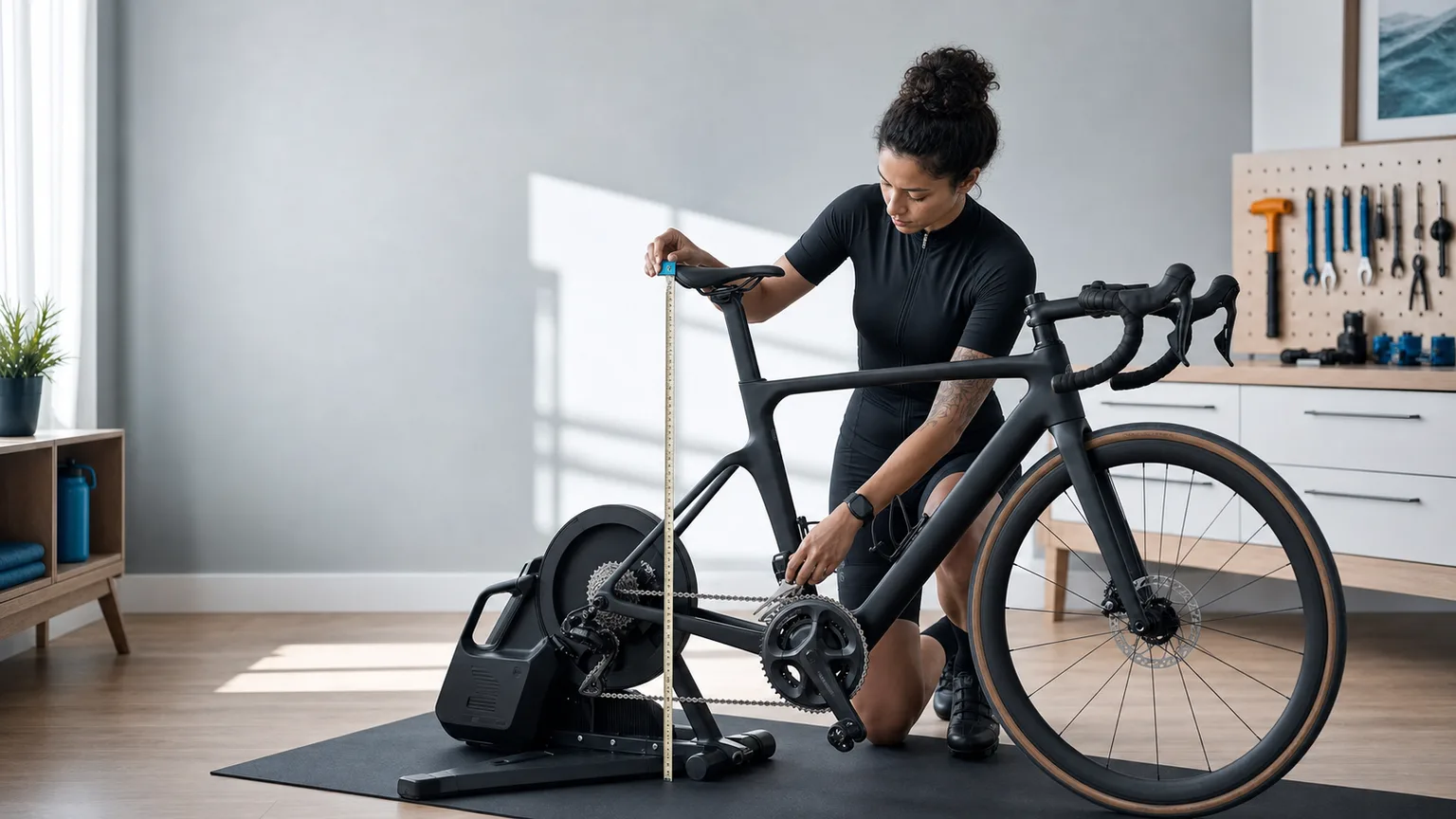
- Set it. Measure from the centre of the crank bolt to the top of the saddle, holding the tape along the seat tube. Loosen the seatpost clamp, set the height, keep the saddle level.
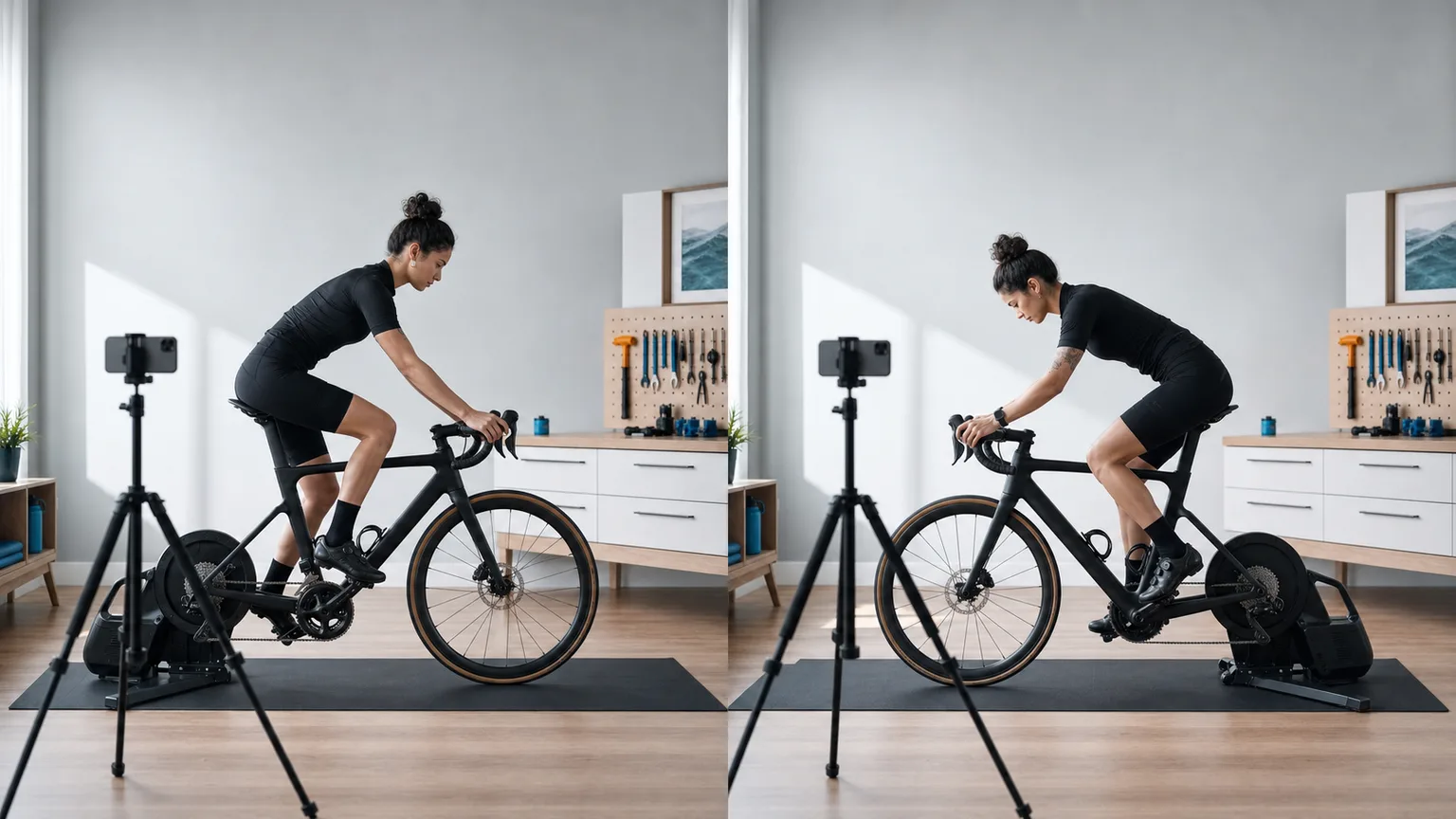
- Verify the angle. Film yourself pedalling from the side (or use our live camera check, which computes the angle every frame). Look for 30–40° of knee bend at the bottom, measured dynamically.
- Adjust in 3–5 mm steps. Small changes, one at a time, 2–3 rides between changes. Your body notices 3 mm; give it time to say so.
Reading the symptoms
- Pain at the front of the knee (around or under the kneecap) can be associated with a saddle that's too low — more flexion means more patellofemoral pressure. If measurement supports that hypothesis, a small rise within the reference range changes the force in the expected direction (Bini 2011).
- Pain behind the knee or high in the hamstrings can be associated with a saddle that's too high; verify extension before making a small reversible trial.
- Hips rocking on the saddle, or reaching with your toes: too high.
- Feeling cramped, knees coming up high, sit bones going numb from constant pressure: usually too low.
One caveat worth its own sentence: if knee pain persists off the bike, wakes you at night or gets worse over weeks, stop adjusting and see a physiotherapist or doctor — position tweaks are for mechanical niggles, not injuries.
Practical questions
Frequently asked questions
What is the correct saddle height?
One that leaves your knee bent 25–35° at the bottom of the pedal stroke (measured statically), or 30–40° measured while actually pedalling. As a starting estimate, 0.883 × your inseam from the bottom bracket to the saddle top gets most riders close; the knee angle decides.
How do I know if my saddle is too high?
Classic signs: your hips rock side-to-side, your toes point down to reach the pedal, and you feel stretch or pain behind the knee or in the upper hamstrings. Measured, your knee would bend less than ~25° (static) at the bottom of the stroke.
Can saddle height cause knee pain?
Saddle height changes knee flexion and joint loading, so it can be one contributor. Pain location is only a hypothesis: verify the angle, test one small reversible change, and seek qualified assessment for persistent or off-bike symptoms.
Does crank length change saddle height?
Yes, one-for-one. The pedal at the bottom of the stroke sits one crank-length below the bottom bracket, so if you switch to cranks 5 mm shorter, raise the saddle ~5 mm to keep the same knee extension.
How accurate are saddle-height formulas?
As starting points: decent. As answers: poor. Peveler & Green (2011) found the 109% formula left 73% of riders outside the recommended knee-angle window, because formulas can't see your individual femur/shin proportions.
Evidence trail
Sources
- peer-reviewedHolmes J.C., Pruitt A.L., Whalen N.J. (1994). Lower extremity overuse in bicycling. Clinics in Sports Medicine, 13(1):187–205
- systematic reviewBini R., Hume P.A., Croft J.L. (2011). Effects of bicycle saddle height on knee injury risk and cycling performance. Sports Medicine, 41(6):463–476
- peer-reviewedPeveler W.W. (2008). Effects of saddle height on economy in cycling. Journal of Strength and Conditioning Research, 22(4):1355–1359
- peer-reviewedPeveler W.W., Green J.M. (2011). Effects of saddle height on economy and anaerobic power in well-trained cyclists. Journal of Strength and Conditioning Research, 25(3):629–633
- peer-reviewedFerrer-Roca V., Roig A., Galilea P., García-López J. (2012). Influence of saddle height on lower limb kinematics in well-trained cyclists: static vs. dynamic evaluation. Journal of Strength and Conditioning Research, 26(11):3025–3029
- peer-reviewedFonda B., Sarabon N., Li F.-X. (2014). Validity and reliability of different kinematics methods used for bike fitting. Journal of Sports Sciences, 32(10):940–946
- conventionLeMond G., Gordis K. (method: C. Guimard) (1987). Greg LeMond's Complete Book of Bicycling. Perigee Books
- peer-reviewedHamley E.J., Thomas V. (1967). Physiological and postural factors in the calibration of the bicycle ergometer. Journal of Physiology, 191:55–56P